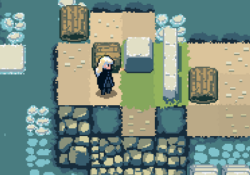
We Become What We Behold is a short interactive game that examines how attention and repetition influence behavior within a closed community. The player observes a small group of characters who move through a shared public space. At the beginning, their actions appear neutral and routine, with no visible conflict or hierarchy. The player’s role is not to control characters directly, but to select moments to record and highlight. These recorded moments then shape how the group reacts and evolves over time.
Observation As A Game Mechanic
The central mechanic of We Become What We Behold is observation through a camera tool. The player decides which interactions are worth focusing on and which are ignored. Once an event is captured, it becomes amplified within the system, affecting how characters perceive each other. The game does not explain these effects directly, requiring the player to notice changes through repeated cycles. This structure turns passive watching into an active force that drives progression.
Player Actions And Feedback Loop
The player’s influence is limited to a small set of actions that repeat throughout the session:
- choosing which interactions to record
- framing scenes through the camera view
- ignoring uneventful behavior
- reacting to crowd responses
- continuing or stopping observation
Each action feeds into a loop where recorded behavior becomes more common. The game reinforces the idea that selection itself carries weight, even when the action seems minor. Over time, neutral interactions become less frequent, replaced by behaviors that reflect what has been given attention.
Escalation And Pattern Formation
As the loop continues, characters begin to imitate the highlighted behavior. This imitation is not immediate but builds gradually, creating visible patterns in movement and interaction. The environment remains unchanged, which places emphasis entirely on social shifts rather than physical progression. The player is not given tools to reverse changes, only to continue observing them.
Later stages reduce the amount of neutral activity available to record. The system narrows the range of possible outcomes, making it harder to find moments that do not fit established patterns. This restriction reinforces the consequences of earlier choices and removes the illusion of full control.